.svg?width=93&quality=80&auto=webp&format=auto&cache=true&immutable=true&cache-control=max-age%3D31536000 "Home")


.svg?width=7&quality=80&auto=webp&format=auto&cache=true&immutable=true&cache-control=max-age%3D31536000 "Top Navigation - Sign in - Icon")

Remote access VPN has long served us well, but the recent increase in remote working has cast a spotlight on the limitations of this aging technology. While some organizations continue to extract every bit of mileage they can from VPN, many are looking for a better alternative – something that addresses the challenges with remote access VPN. Several organizations have already started to fully embrace the next-generation of remote access technology: ZTNA or zero trust network access. ZTNA offers better security, more granular control, increased visibility, and a transparent user experience compared to traditional remote access VPN.
In this ZTNA buyers guide we will examine the limitations and challenges with traditional remote access VPN and the benefits that zero trust network access can provide and summarize with a shopping list of critical capabilities you should be looking for in your new ZTNA solution.
Challenges with remote access VPN
Remote access VPN has been a staple of most networks for decades, providing a secure method to remotely access systems and resources on the network. However, it was developed during an era when the corporate network resembled a medieval fortification – the proverbial castle wall and moat that formed a secure perimeter around network resources within. VPN provided the equivalent of a secure gatehouse for authorized users to enter the safe perimeter, but once they were in, they had full access to everything within the perimeter.
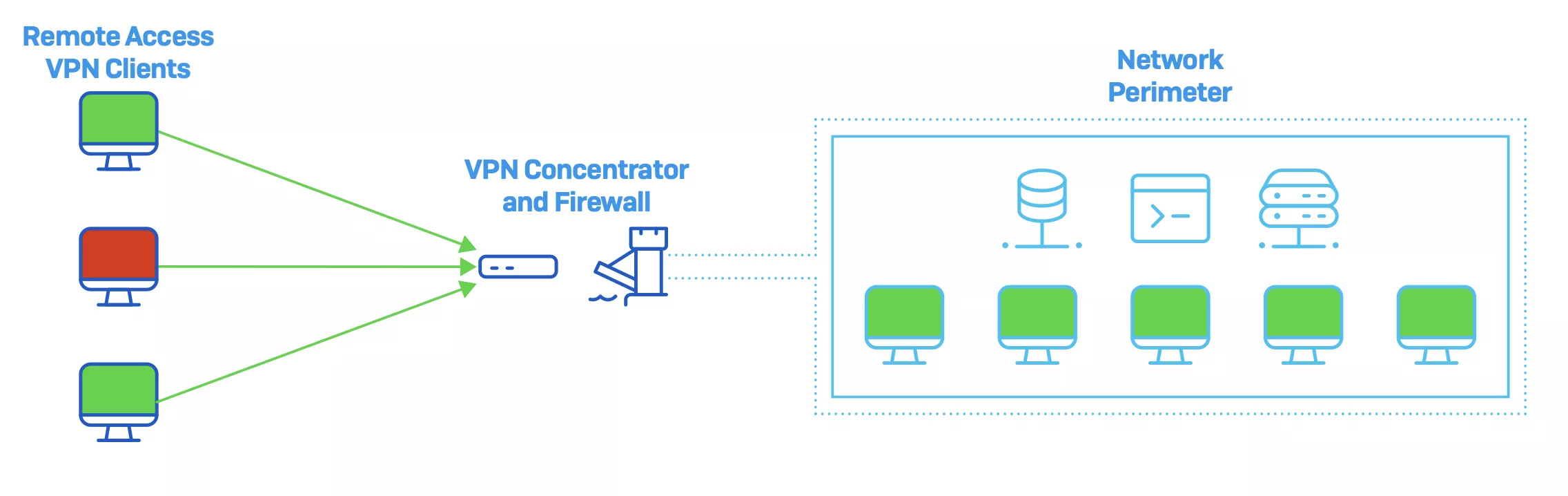
Of course, networks have evolved substantially, being more distributed than ever. Applications and data now live in the cloud, users are working remotely, and networks are under siege by attackers and hackers looking for any weakness to exploit.
Administering a remote access solution based on traditional VPN (IPSec/SSL) in any kind of modern environment can be extremely painful. You have to contend with IP management, traffic flows and routing, firewall access rules, as well as client and certificate deployment and configuration. Anything beyond a handful of nodes and a few dozen users turns this into an unnecessary full-time job - just to keep this running. If that wasn't enough, security becomes an absolute nightmare to monitor and control.
In summary, traditional remote-access VPN has a number of unnecessary limitations and challenges:
- Implicit Trust – Remote access VPN does a good job of getting you through the perimeter and onto the corporate network as if you were physically there, but at that point, you’re implicitly trusted and given broad access to the resources on that network which may present unnecessary and enormous security risks.
- Potential Threat Vector – Remote access VPN has no awareness of the state of the device used to connect to the corporate network, creating a potential conduit for threats to enter the network from devices that may have been compromised.
- Inefficient Backhauling – Remote access VPN provides a single point-of-presence on the network, which will potentially necessitate backhauling of traffic from multiple locations, datacenters, or applications through the remote access VPN tunnel.
- Lack of Visibility – Remote access VPN is unaware of the traffic and usage patterns it is facilitating making visibility into user activity and application usage more challenging.
- User Experience – Remote access VPN clients are notorious for offering a poor user experience, adding latency or negatively impacting performance, suffering from connectivity issues, and generally being a burden on the helpdesk.
- Administration, Deployment and Enrollment – Remote access VPN clients are difficult to setup, deploy, enroll new users, decommision departing users. VPN is also challenging to administor on the firewall or gateway side, especially with multiple nodes, firewall access rules, IP management and traffic flows and routing. It quickly becomes a full time job.