


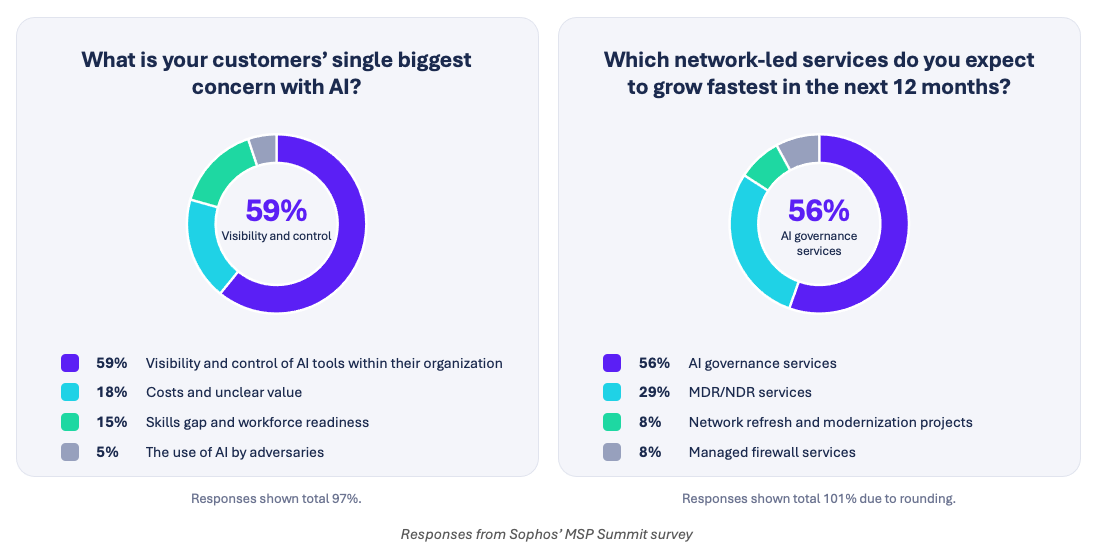
These responses are unsurprising. AI is the most rapidly adopted and used technology of the digital age. The result is that many security and risk leaders have watched it become embedded within operations without the necessary governance being applied in advance. This has created critical exposures which must now be addressed after the fact.
Organizations need a structured way to regain visibility and control as AI adoption expands, which is where managed AI governance services come in: helping customers establish the policies, controls, and oversight needed to manage risks ranging from shadow AI and data exposure to access and compliance. For MSPs, MSSPs, and other providers, these services also offer a vehicle for deeper, more strategic customer relationships.
As our new e-book — Building an AI governance practice: A guide for MSPS — reveals, however, not everyone is ready to respond.
Governance always gets forgotten
Governance has long been the missing strategic layer in security. It was only in 2024 that NIST introduced the “Govern” function to its Cybersecurity Framework (CSF), adding the strategic, operational, and cultural layer that underpins the other five security functions and guides how they are prioritized, resourced, and managed.
Add to this that only one in approximately 10,000 organizations has a CISO, and it becomes clear why governance remains underdeveloped. Its formal recognition came relatively late, and dedicated leadership remains scarce, leaving it to compete with other operational priorities. All things considered, it is perhaps no wonder that most organizations still operate without an established governance and risk assessment program.
AI only magnifies these gaps. Organizations are being asked to govern a technology that is evolving rapidly, spreading across the business, and introducing new risks and use cases, often without the ownership, policies, and processes needed to govern the technology they already have.
AI governance, then, is less a wholly new governance problem than an acceleration of existing weaknesses in cybersecurity governance. Organizations have invested heavily in security technology, but persistent strategy gaps mean AI adoption is now testing governance structures that were already under strain.
The consequence of governance gaps
Those gaps have real consequences as AI becomes more deeply ingrained. According to IBM’s Cost of a Data Breach Report 2026, 92% of organizations that experienced an AI-related breach lacked proper AI access controls, while incidents involving shadow AI also led to an average breach cost of $5.39 million. These figures, among others, show how quickly weak governance can become a consequential liability.
With Gartner predicting that more than 40% of enterprises will experience a security or compliance incident linked to unauthorized shadow AI security risks by 2030, it looks like that problem is set to grow. As AI adoption expands faster than organizations can control it, today’s governance gaps will become tomorrow’s crises.
MSPs are well positioned to help
For MSPs, this lack of coverage creates a significant opportunity. Customers need help strengthening their cybersecurity governance, period, and adapting those foundations to an AI landscape that is changing what needs to be governed, how quickly, and across how much of their organization.
MSPs already provide much of the security expertise and ongoing oversight those customers lack internally, making them the natural leaders to address both needs. With 84% of managed service providers (MSPs) expecting demand for CISO-level services to increase over the next 12 months, governance in general, and its AI evolution, represent a natural extension of that growing strategic role.
Are MSPs ready to deliver AI governance?
Recognizing the opportunity is one thing, but turning it into a portfolio of valuable, repeatable managed AI governance services is another. There are a number of readiness challenges that MSPs must first address.
Stop talking about tools and focus on risk
AI governance cannot be reduced to deciding which tools customers should allow or block. MSPs need to move the conversation towards how AI changes risk across the organization and how that risk should be managed in context.
Scale your own governance capabilities
Customer demand cannot be met through ad hoc guidance that depends on individual expertise. MSPs need a consistent approach that can be applied across customers as their AI use, risk exposure, and regulatory obligations evolve.
Demonstrate AI governance from the inside out
MSPs are adopting AI within their own businesses, exposing them to many of the same visibility, ownership, and control challenges as their customer base. Tackling those internally gives them the practical experience and credibility needed to guide customers through the same process.
Building an AI governance practice: A guide for MSPs
Our new e-book, Building an AI governance practice: A guide for MSPs, examines the state of AI adoption, the cyber and operational risks it creates, and the readiness of MSPs and other partners to build a successful AI governance portfolio. It also provides a practical blueprint for building a credible, repeatable service, beginning within your own MSP business.
As Omdia observes in its MSP Analysis January 2026: “The most successful MSPs deploy AI first within their own operations to drive efficiency, improve service quality, and build repeatable intellectual property. This internal adoption then becomes the foundation for monetized customer-facing AI services.”
By confronting their own AI governance challenges first, MSPs can develop and test the policies, processes, controls, and expertise they will eventually need to deliver to customers. The result is a stronger internal governance posture and a more credible foundation for an AI governance practice that delivers consistent recurring revenue.
Read the guide here.
Ready to speak to customers about AI governance?
If you already have the expertise to lead AI governance conversations, Sophos AI Defense is the solution you need to discover and control customers’ AI use, protect sensitive data, and bring AI-related risk into established security workflows. Log in to the Sophos Partner Portal and explore the Sophos AI Defense Partner Playbook to learn how.