


This year’s State of Ransomware in Retail report showed significant improvement in the sector’s ransomware outcomes mixed with a few concerning new trends.
Retail organizations paid less money to attackers than any other sector and had the fastest recovery times of any year in the survey’s history. But ransomware encryption rates are up by 14 percentage points compared to last year. The sector’s average recovery cost also rose this year to $1.76 million.
The sixth annual Sophos State of Ransomware in Retail report is now available, with findings from 217 IT and cybersecurity leaders in retail organizations that were hit by ransomware in the last 12 months. The survey was administered from January to March 2026.
Click here to access the full report now.
Exploited vulnerabilities hit retail harder than any other sector
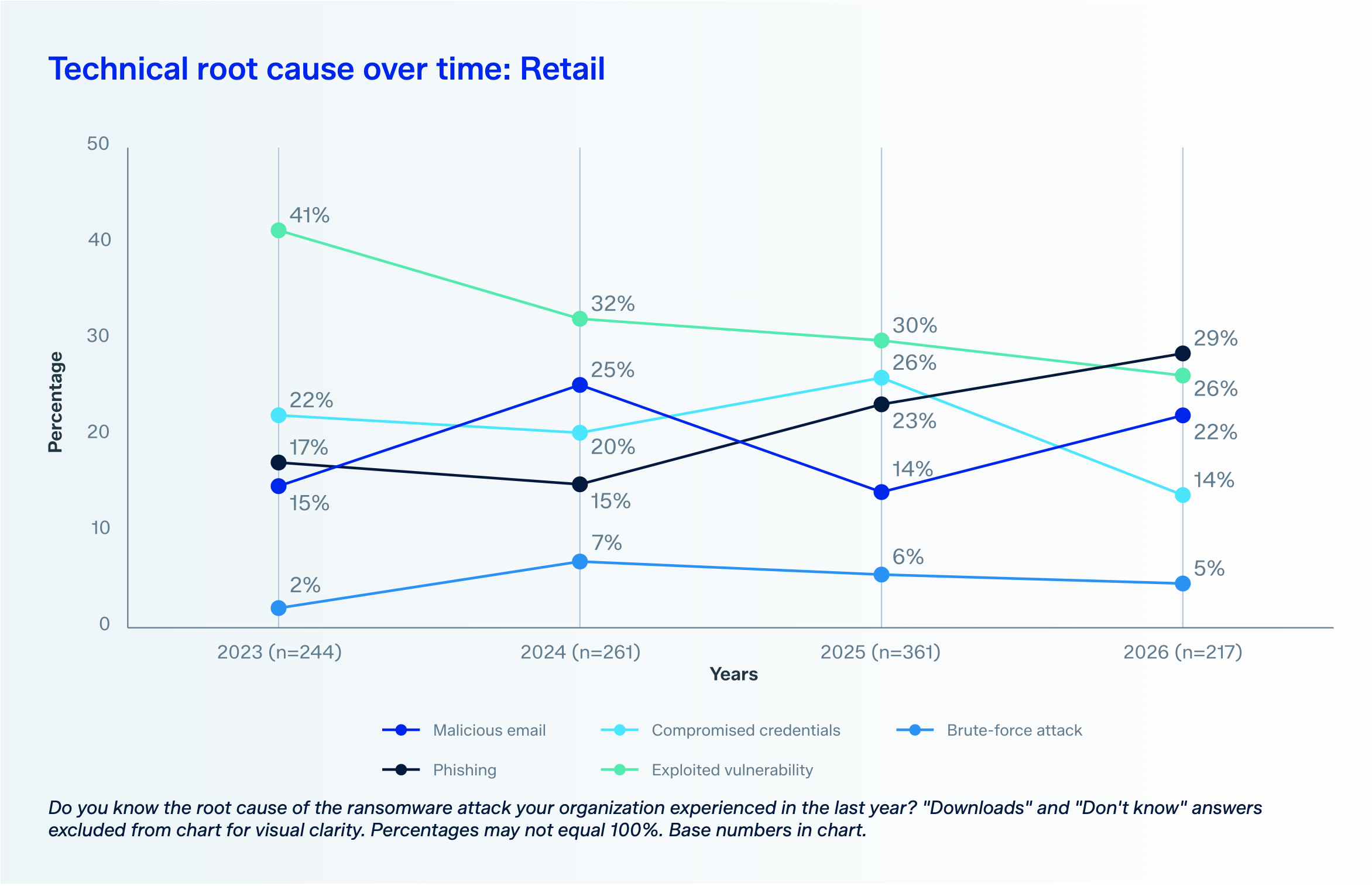
Exploited vulnerabilities declined as a technical root cause across all sectors in 2026, but they still started 26% of attacks on retail organizations. That's the highest rate of any sector and well above the 18% cross-sector rate.
Phishing was the top technical root cause for retail at 29%, followed by exploited vulnerabilities (26%) and malicious email (22%).
Identity-based vectors, including malicious email, phishing, compromised credentials, and brute force attacks, initiated 69% of attacks against retail. This was the lowest rate of any sector yet still well above half of respondents. 66% of retail victims said their ransomware attack was also their most significant identity attack, close to the 67% cross-sector rate featured in our State of Identity Security 2026 report earlier in the year.
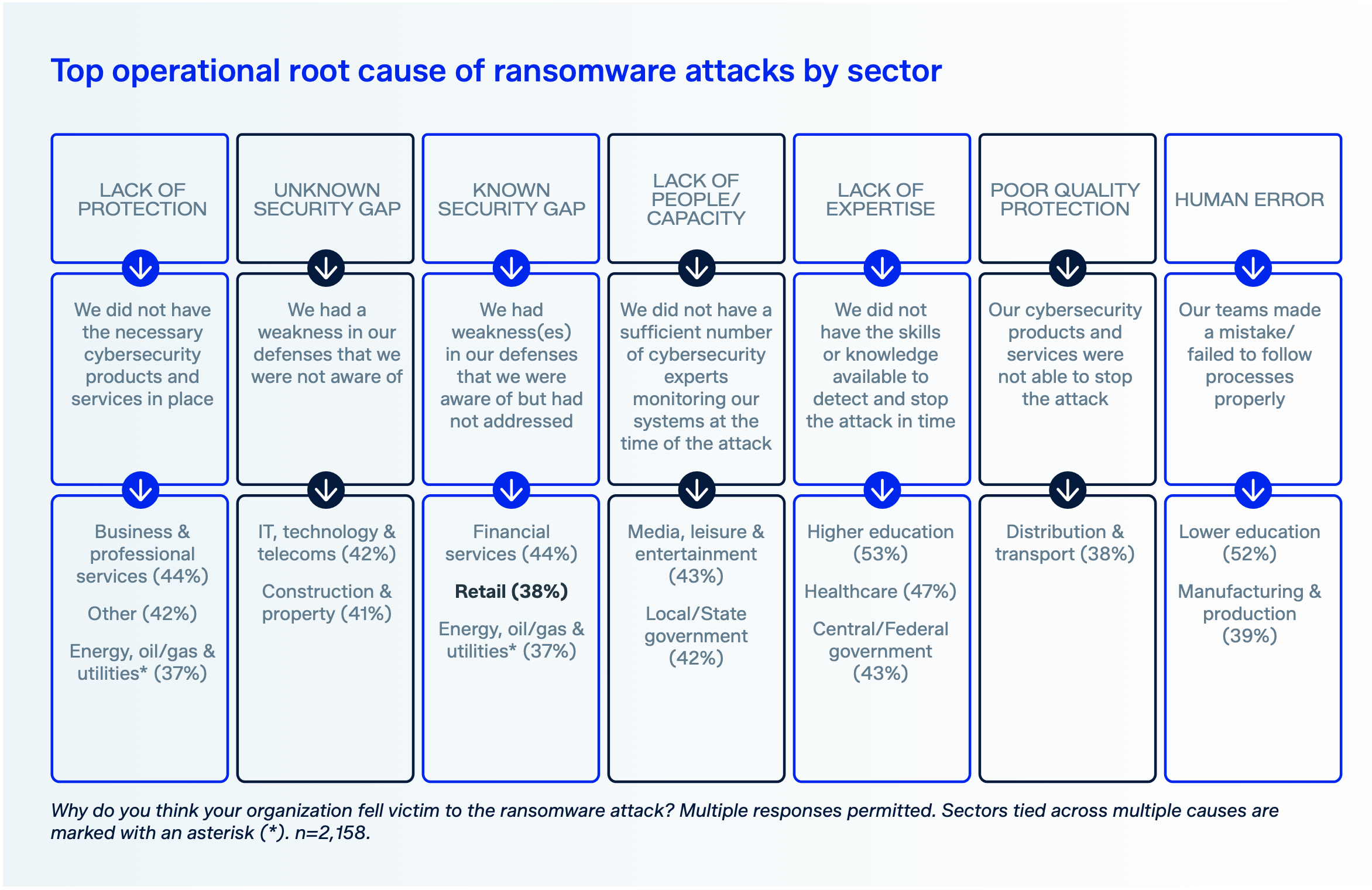
Known security gaps were retail’s one above-average weakness
38% of retail victims attributed their breach to a known security gap, a weakness they were aware of but had not addressed. That was retail’s most common operational root cause and the only one it cited more often than the 36% cross-sector rate.
Every other operational root cause came in below the cross-sector rate. The report compares each one in detail.
Encryption climbed after two years of decline
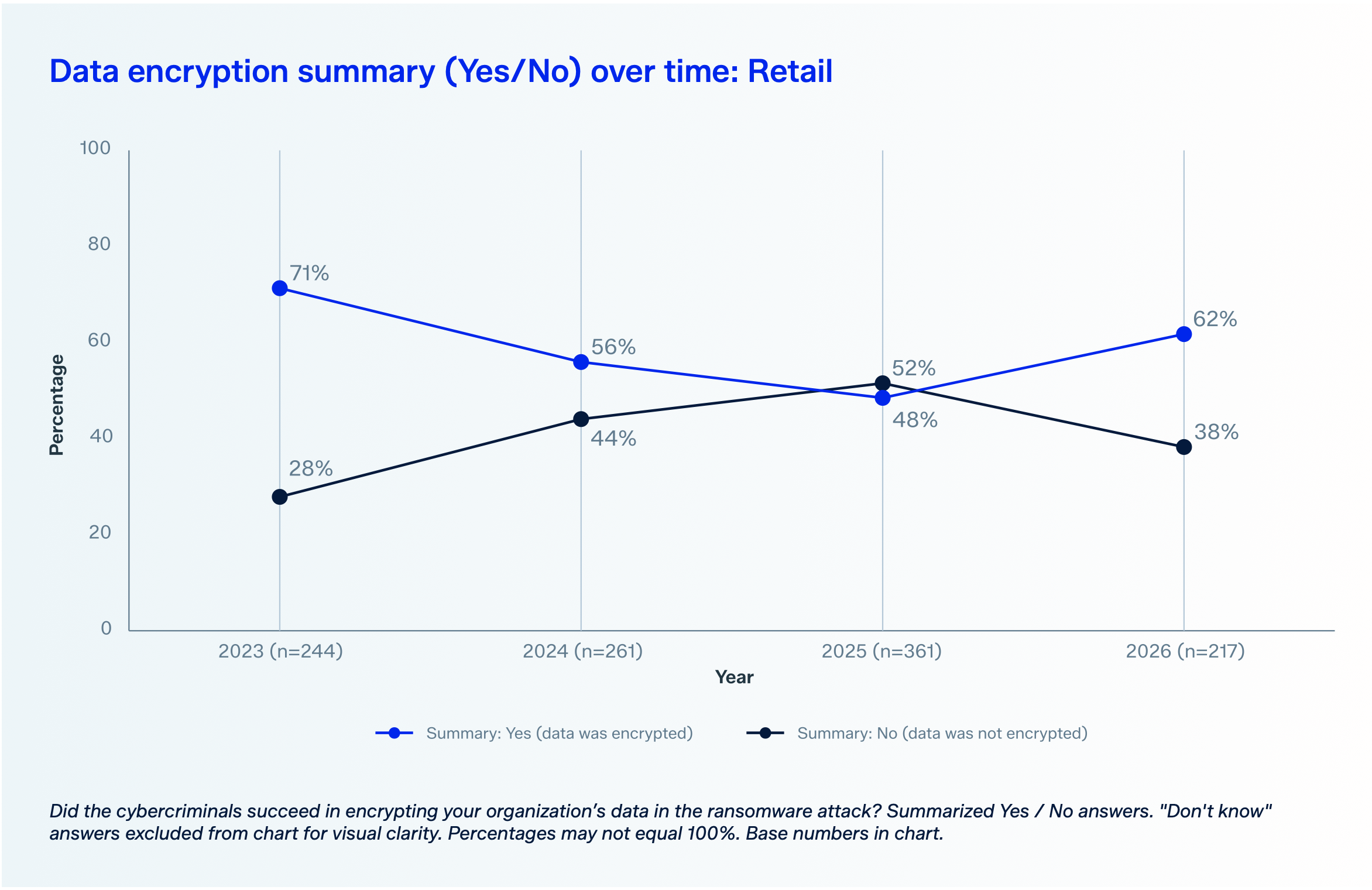
62% of attacks on retail succeeded in encrypting data, up from 48% in 2025 and above the 56% cross-sector rate. Attacks that encrypted data and also stole it rose to 19%, up from 14% last year. That second point of leverage weighs heavily on retailers holding customer payment and personal data.
Backups did most of the recovery work: 71% of retail organizations restored data from backups, up from 62% last year and above the 66% cross-sector rate. Far fewer retailers paid the ransom to get their data back than in 2025. The full report shows where retail’s payment rate ranks against other sectors.
Low typical ransoms, with a heavy top end
The median ransom demand for retail was $225,000, the second lowest of any sector and far below the $698,000 cross-sector median. The average (mean) demand was $4.32 million, the highest of any sector. That average does not include outlier ransoms of $40 million or more. These ultra-high ransoms were excluded from the report results to prevent skewing of averages.
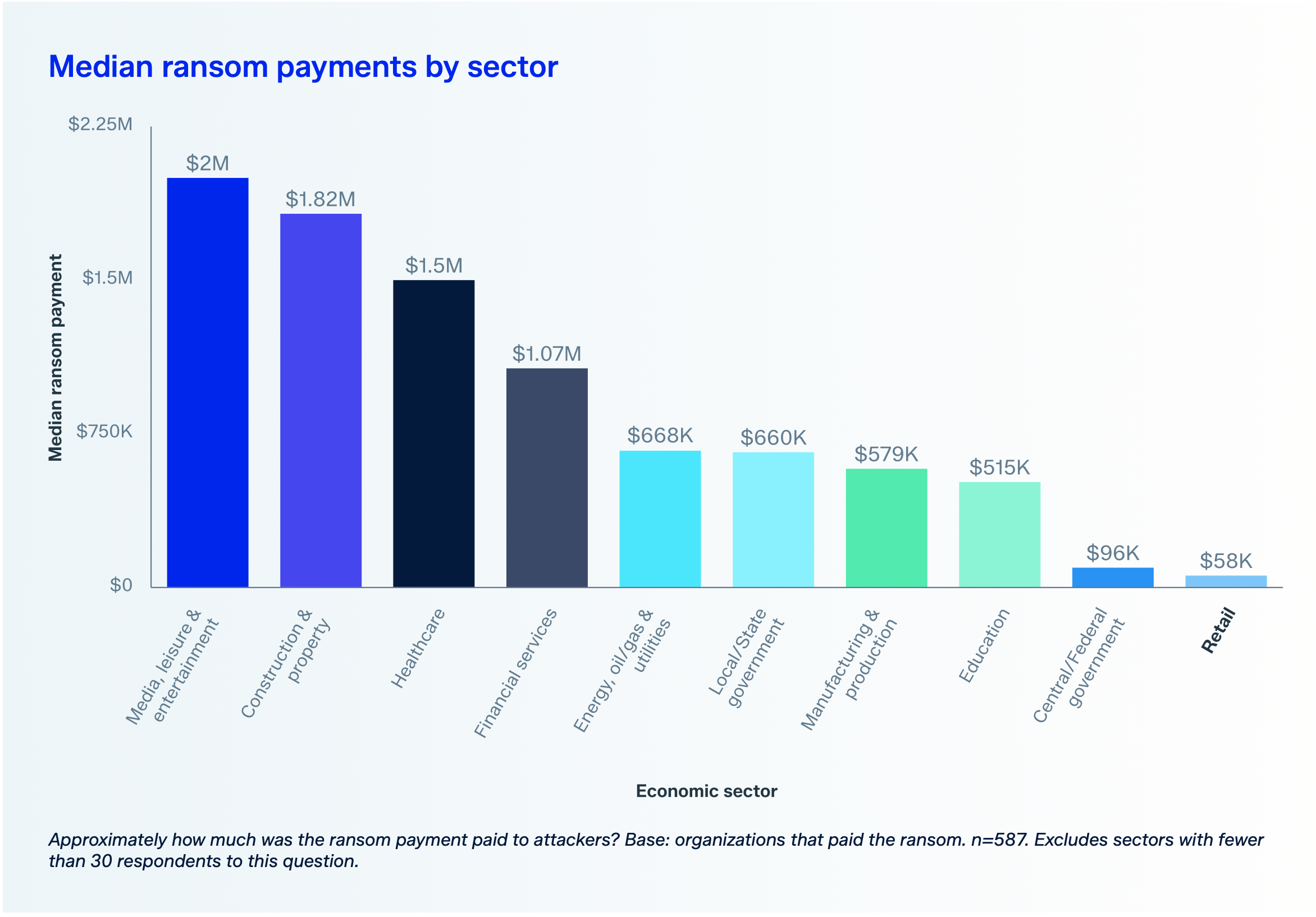
The median ransom payment for retail was also low at $57,500, the lowest of any sector and well below the $769,000 cross-sector median.
The report explains what pushed retail’s average demand to the top of the sector rankings and how far retailers negotiated attackers down.
Recovery got faster, but costs went up
The average (mean) cost to recover from an attack, excluding any ransom paid, rose to $1.76 million from $1.65 million last year. That was slightly above the $1.70 million cross-sector average, which also rose this year.
But on the positive side, retail’s average time to fully recover fell to 2.54 weeks from 3.16 weeks last year. 56% recovered within a week, the highest share in five years of retail data. The rate of 2.54 weeks is also below the 2.80-week cross-sector average, making 2026 a strong year for quick recoveries.
Defenses saw the attack, but did not stop it
Almost all retail victims of credential-based attacks had MFA enabled (97%), yet more than half still had data encrypted by attackers. Firewalls flagged 59% of attacks before the ransomware deployed, but even with early indicators, victims were encrypted 60% of the time, compared with 50% across all sectors.
Controls in retail are collecting the right signals, but they’re not connecting deeply enough with other tools and responding together. The report contains several key recommendations based on this year’s data, and one of those recommendations is to adopt a defense system posture where identity, email, endpoint, and network controls respond as one.
Read the report
Retail is paying attackers less than any other sector and recovering faster than in any year of our data. But more attacks are reaching encryption, and the cost to recover went up. Closing known security gaps and connecting existing defenses are the highest-leverage places for retailers to invest in.
Download the free report for the full findings, sector comparisons, and recommendations.