


This article is part of an ongoing series from Sophos frontline security specialists sharing lessons from authorized security testing engagements. Client information and selected operational details have been anonymized and generalized.
Physical security usually looks strongest from the outside. Cameras. Guards. Badge readers. Locked doors. Visitor procedures.
Each control may work exactly as designed. The harder question is whether they still work when somebody deliberately connects the gaps between them.
That is what a Sophos Physical Penetration Test is designed to examine. Rather than reviewing policies from a conference room, Sophos testers safely simulate an adversary attempting to enter a facility, move into sensitive areas, exploit workplace trust, and determine whether physical access can become digital access.
The following diagram shows the generalized attack chain assessed in this engagement, along with the places where alert employees, security personnel, access systems, network controls, and hardened devices can interrupt it.
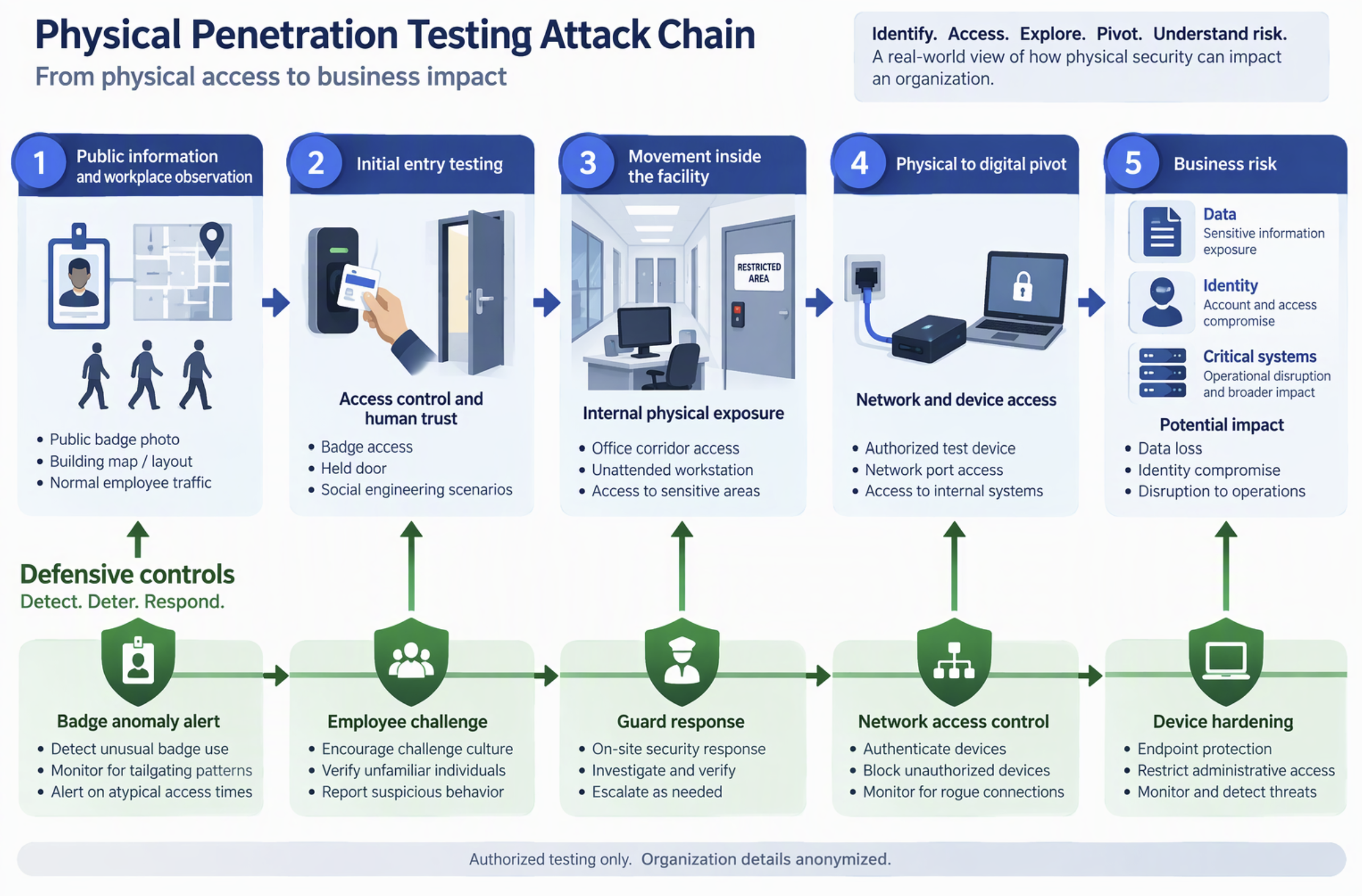 Figure 1: Physical Penetration testing attack chain showing how public information, access control gaps, workplace trust, and internal technical exposure can combine, with detection opportunities at every stage.
The building was not the first target
The engagement started before anyone approached a door. The Sophos Red Team reviewed public information and studied how people moved around the facility. Public images revealed details about the property, its entrances, and the appearance of employee credentials. Onsite observation provided the rest: where people entered, how badges were carried, which areas were busy, and where an unfamiliar face might blend in. None of this required breaking a window or picking a lock.
A photograph shared for an innocent reason can reveal more than the person posting it intended. A badge image can expose its visual design. A building photo can show where reception sits. A normal workplace rhythm can reveal when entrances are crowded and attention is divided.
Individually, these details may appear harmless. Together, they can become a plan.
A valid badge does not always mean a valid person
Using information gathered during reconnaissance, the team demonstrated that access badge data could be captured and written to test credentials and cloned onto a fake badge. Those credentials allowed entry into parts of the facility and access to internal areas that should have required stronger validation.
 Figure 2: Fake access badges created using badge data captured during reconnaissance, allowing the team to gain access to restricted areas of the facility.
Once a door accepted the credential, the environment largely treated the person carrying it as legitimate. That is an important distinction. A badge reader answers a narrow question: “Is this credential valid?” It does not necessarily answer the more important question: “Is the person presenting it authorized to be here?”
Employees encountered unfamiliar people moving through workspaces but did not consistently challenge them. Tailgating attempts also succeeded when people held doors or accepted a simple forgotten badge explanation. There was no dramatic confrontation. People were being helpful.
That is exactly why this type of penetration testing matters.
Inside, the trust boundary changed
After entry, the team identified unlocked workstations, unattended laptops, visible technical information, and gained access to internal network equipment. An authorized testing device placed beneath an unused workspace successfully established internal network connectivity.
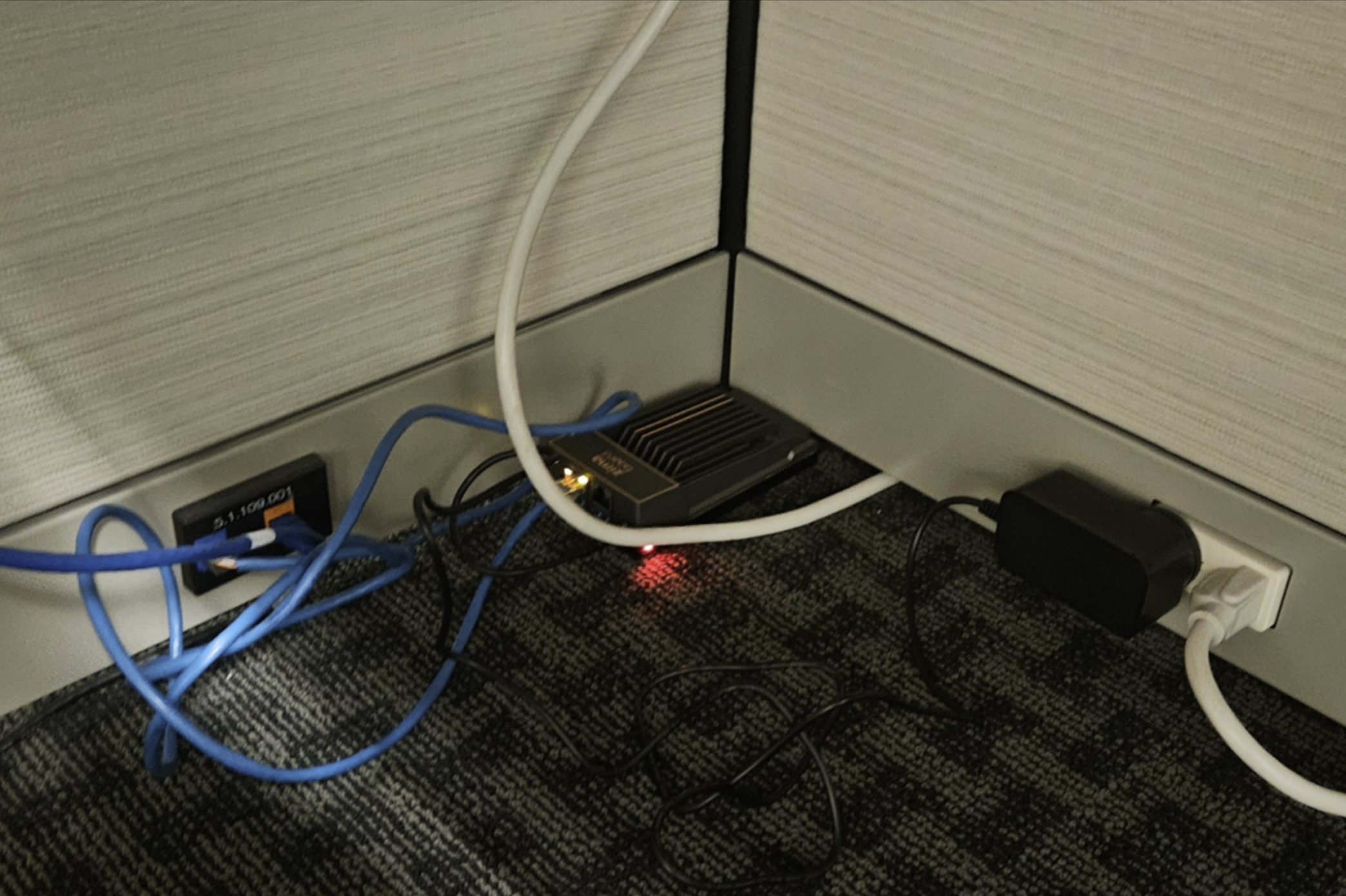
Figure 3: An authorized testing device placed beneath an unused workspace.
That was the moment the engagement stopped being only a facilities issue. Physical access had become network access.
The assessment demonstrated that a person who entered the building could potentially reach internal systems without first defeating the organization’s internet facing defenses. The concern was not one specific port or one specific desk. The broader issue was that internal network access was being granted based largely on physical proximity rather than strong device authentication.
The team also encountered unattended and unlocked laptops in shared areas. These could provide an intruder with immediate access to applications, documents, communications, or a place to install persistence.
Once someone is inside, the workspace itself becomes part of the attack surface.
Encryption worked until another process failed
A test laptop provided another useful lesson. Full disk encryption initially prevented straightforward access to the device’s data. That control did its job. The team could not simply remove or mount the drive and read its contents. That's when the attack path changed.
Instead of attacking encryption directly, the testers evaluated the process used to recover the device. A believable support request resulted in the release of recovery information without sufficient identity verification. Combined with separate weaknesses in boot protection and privilege controls, that recovery information allowed the team to demonstrate a complete compromise of the test device.
The lesson is not that encryption failed. Encryption held. The recovery process around it did not.
Security controls rarely operate alone. Strong encryption can be undermined by weak recovery procedures. Strong endpoint protection can be undermined by insecure boot settings. Strong authentication can be undermined by a support process that trusts a believable story.
Some defenses did exactly what they were supposed to do
This was not a story where everything failed. The badge system generated alerts when cloned credentials were used in ways that did not match normal behavior. Security personnel raised their awareness, increased patrol activity, challenged a tester, confiscated the suspicious badge, and escalated the situation. Later attempts using invalid credentials were rejected, and additional security attention caused the team to abandon some entry routes. An employee disconnected the planted testing device, ending the team’s remote network connection. The employee may not have known exactly what the device was, but the action disrupted the attack path. These outcomes matter. A useful penetration test should not only document failures. It should identify the controls, decisions, and employee behaviors that interrupted the attack so those strengths can be reinforced.
The cheapest control may be a conversation
One of the clearest lessons from this Sophos Red Team engagement was that an unfamiliar person moving through a restricted workplace should not be able to rely on everybody assuming someone else has already verified them. Employees do not need to become security guards. They do need a safe, simple way to acknowledge unfamiliar people, offer assistance, and escalate concerns.
CISA’s “Power of Hello” guidance recommends observing suspicious behavior, initiating a polite conversation, evaluating the situation, and obtaining help when appropriate. Even a friendly “Can I help you find somebody?” can establish that a person has been noticed and may expose a weak pretext. Security awareness should make that response feel normal, not confrontational.
What organizations should take from this
This engagement was one anonymized example, not a claim that every facility has the same weaknesses. The broader lessons are widely applicable:
- Protect badge information. Avoid publishing clear images of access credentials. Use badge technology that resists copying and limit each credential to the minimum areas required.
- Require individual access. Employees, contractors, and visitors should authenticate or follow the visitor process rather than enter through ordinary courtesy.
- Make polite challenges normal. Give employees simple language, a safe escalation path, and clear permission to report unfamiliar people or unusual activity.
- Assume entry may eventually happen. Lock workstations automatically, secure sensitive documents, restrict internal rooms, and prevent unknown devices from receiving network access.
- Harden recovery processes. Help desk and device recovery procedures should verify identity through trusted channels before releasing keys, resetting authentication, or granting elevated privileges.
- Connect physical and cyber monitoring. Badge anomalies, visitor records, guard reports, network connections, and identity recovery events should contribute to a shared view of suspicious activity.
- Test the whole chain. NIST guidance recommends structured security testing that includes planning, execution, analysis, and mitigation. Physical penetration testing adds value because it tests whether several individually reasonable controls can still be chained together.
The biggest lesson is not that organizations need more locks. It is that technology, process, people, and culture have to support one another.
A badge reader cannot challenge a convincing story. A locked door cannot protect an unattended laptop. Encryption cannot compensate for weak recovery verification. A network control cannot stop an unknown device if physical presence is treated as authorization. Layered security works only when the layers remain connected.
Want to know what happens when somebody tests your locks, your badges, your people, and the controls behind the front door? Sophos Red Team has delivered thousands of offensive security engagements, and our Security Services Retainer lets you draw on everything from Offensive Security Services to DFIR & Readiness Services with the flexibility to pivot whenever your priorities change. We're happy to help.